Progesterone can enter a menopause discussion for two very different reasons: relieving symptoms or protecting the lining of the uterus when estrogen is used. A randomized trial of oral micronized progesterone alone addressed the first question. In healthy postmenopausal volunteers, it found lower hot-flash and night-sweat scores than placebo over 12 weeks. Understanding that result requires keeping symptom scores, episode counts, treatment discontinuations, and uterine outcomes separate.
This analysis uses the indexed primary report abstract for the postmenopausal trial, the accessible full research article for a separate perimenopausal trial, and official US labeling and FDA material. The postmenopausal trial’s full protocols and supplements were not examined. The central finding is credible evidence of a short-term symptom effect in a selected population—not evidence that every progesterone product, menopause stage, or reason for treatment is interchangeable.
Study facts at a glance
Population: The trial randomized 133 healthy women aged 44–62 who were 1–10 years past their final menstrual period. Source 1
Historical intervention: The study compared oral micronized progesterone, 300 mg at bedtime, with placebo for 12 weeks after a four-week baseline period. This identifies the research exposure, not treatment instructions. Source 1
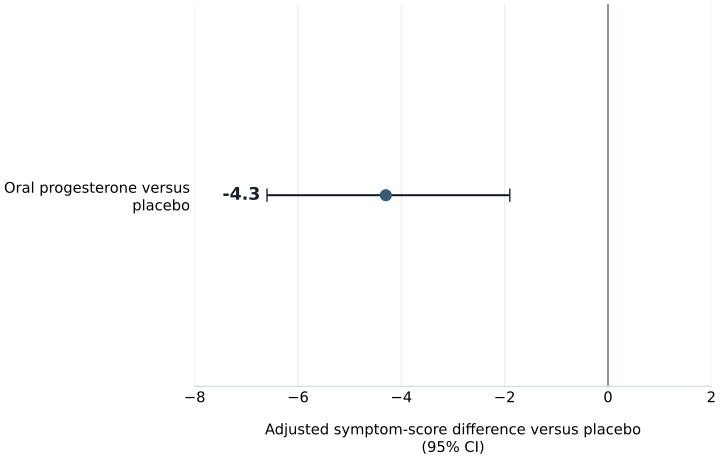
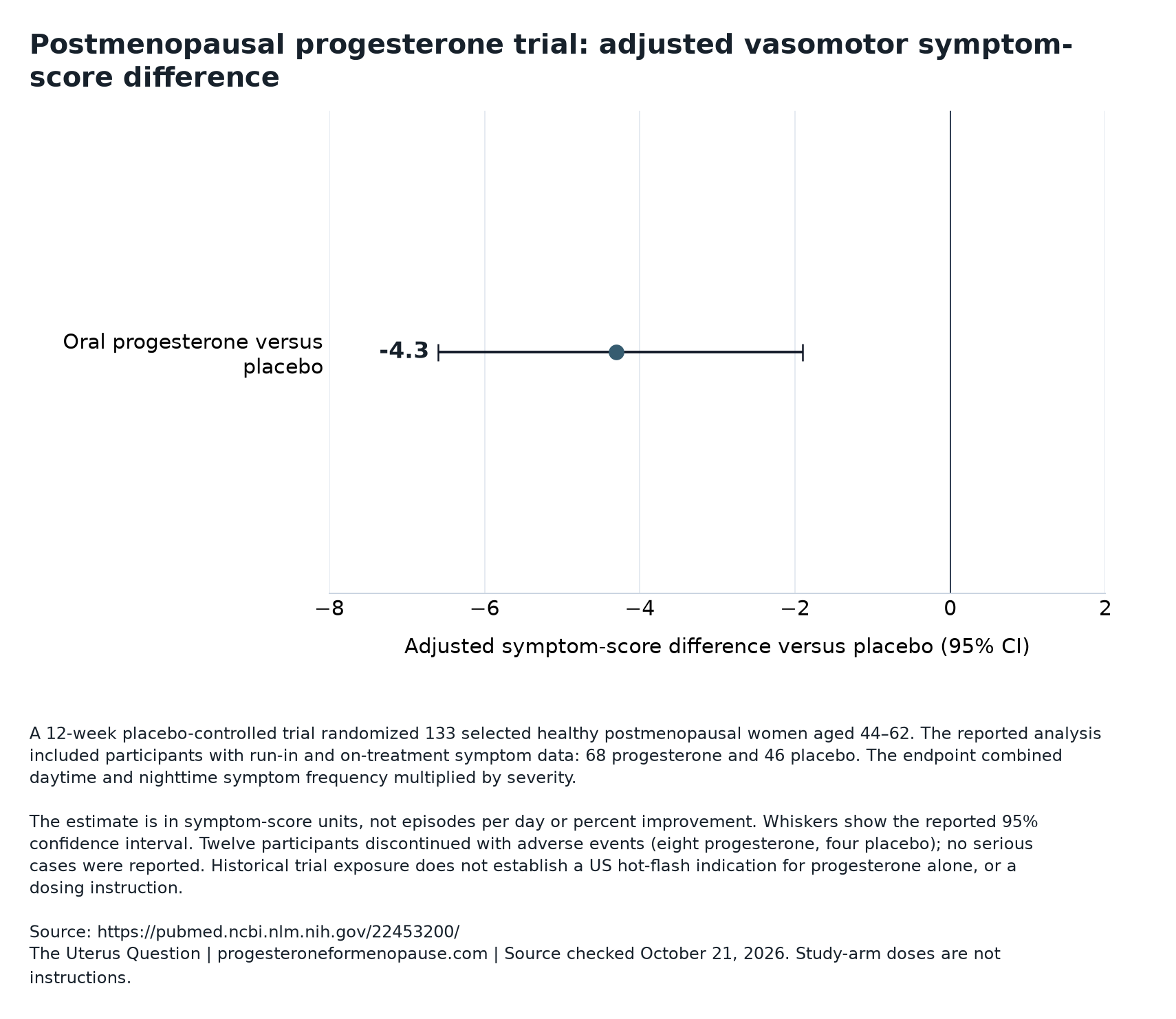
Primary finding: The adjusted between-group difference was −4.3 vasomotor symptom score units, with a 95% confidence interval of −6.6 to −1.9—not 4.3 fewer episodes per day. Source 1
Analysis and adverse events: Symptom analysis included 114 participants. Adverse-event discontinuations were eight with progesterone and four with placebo; the reported 9% describes the overall randomized population. Source 1
US labeling: The PROMETRIUM label lists prevention of endometrial hyperplasia with conjugated estrogen tablets in postmenopausal women with a uterus, and secondary amenorrhea—not progesterone-alone treatment of hot flashes. Source 2
The experiment isolated a progesterone-alone symptom question
The postmenopausal study was randomized, double-blind, and placebo-controlled. Participants were assigned to oral micronized progesterone or an inactive comparison, with neither participants nor investigators knowing the assignment during treatment. Recruitment occurred between 2003 and 2009. Seventy-five women were assigned progesterone and 58 placebo. This design provides a stronger test of a treatment effect than simply asking whether symptoms improved after starting medication.
The intervention lasted 12 weeks, preceded by four weeks of daily symptom recording. The primary endpoint was the average daily vasomotor symptom score during the final 28 treatment days. Vasomotor symptoms, or VMS, means hot flashes and night sweats. Defining a particular final-month outcome matters: the main result describes that window, not necessarily the earliest response, every treatment week, or persistence after treatment.
The historical active arm used 300 mg of oral micronized progesterone at bedtime. That exposure is essential for identifying what was tested, but it is not a recommendation or a labeled hot-flash regimen. There was no estrogen comparison arm, so the experiment cannot rank progesterone against estrogen-based therapy or establish that their benefits are equivalent.
Read the underlying chart data: download CSV or download the source-labeled chart.
Health screening narrowed the population behind the result
Participants were community volunteers aged 44–62, between one and 10 years after final menstruation. They were selected for favorable health characteristics: nonsmoking, body mass index below 35, normal lipids and electrocardiograms, and no diabetes. The study therefore tested symptoms in a screened early-postmenopausal population, rather than a broad cross-section of everyone seeking menopause care.
At baseline, the mean daily VMS score was 17.0, with a standard deviation of 10.4. Mean symptom frequency was 6.8 episodes per day, with a standard deviation of 3.2. A standard deviation describes variation among participants; these values show that the average concealed considerable differences in starting symptom burden. They do not mean each woman experienced approximately seven episodes every day.
Selection improves clarity about the group studied but limits direct extension to older women, smokers, people with diabetes, or those with cardiovascular disease. It also does not settle questions specific to surgery or hysterectomy. The guide to progesterone after hysterectomy addresses why anatomy changes the treatment question even when hot flashes remain a concern.
A combined symptom score is not an episode counter
Women recorded symptom frequency and severity in a daily menopause diary, grading severity from 1 to 4. The daily score combined daytime frequency multiplied by daytime severity with nighttime frequency multiplied by nighttime severity. Consequently, a lower score could reflect fewer episodes, less severe episodes, or both. The primary endpoint intentionally captured more than frequency alone.
As an illustrative calculation, two daytime episodes rated 3 and one nighttime episode rated 2 would produce a score of 8: two times three, plus one times two. If the same three episodes were all rated 2, the score would become 6 without any change in episode count. This example explains the arithmetic; it is not an observed participant result.
The trial’s adjusted difference of −4.3 therefore cannot be translated into 4.3 fewer daily hot flashes. It is also not a 4.3% reduction. A combined day-and-night endpoint does not, by itself, show that both symptom categories improved separately. The abstract’s main estimate supports the combined score, without supplying every component-specific result.
How to read the postmenopausal trial’s main numbers
| Measure | Reported value | Meaning |
|---|---|---|
| Baseline daily symptom burden | Mean score 17.0; mean frequency 6.8 episodes/day | Score and episode frequency use different units. |
| Adjusted treatment comparison | −4.3 score units; 95% CI −6.6 to −1.9 | The primary between-group estimate favors progesterone. |
| Progesterone-arm change | −10.0 score units; 95% CI −12.0 to −8.1 | Within-group improvement includes more than the treatment-specific effect. |
| Placebo-arm change | −4.4 score units; 95% CI −6.6 to −2.2 | Symptoms also improved without active progesterone. |
| Primary assessment window | Final 28 days of 12-week treatment | The estimate concerns the prespecified final-month average. |
The adjusted difference is the comparison to preserve
The primary analysis accounted for the baseline symptom score. Its adjusted mean difference was −4.3 score units, with a 95% confidence interval from −6.6 to −1.9. All values in that interval favor progesterone because lower scores indicate fewer or less severe symptoms. The interval also conveys uncertainty: the evidence supports a range of average treatment effects, not a precisely known 4.3-unit benefit.
The reported mean reductions were 10.0 units with progesterone and 4.4 with placebo. Subtracting those reductions yields 5.6 units, but that arithmetic does not reproduce the baseline-adjusted treatment estimate. The two calculations answer related but different statistical questions. Substituting 5.6 for 4.3 would discard the adjustment used for the primary comparison.
The placebo improvement is scientifically important rather than evidence that symptoms were imaginary. Symptoms fluctuate, and enrollment can occur during an unusually difficult period. Study participation and expectations may also affect reported experience. The abstract cannot separate these explanations. Randomized comparison helps distinguish an additional treatment-associated effect from changes occurring in both arms, although missing outcome data still complicate that inference.
The analysis included 114 women, not all 133 randomized
The abstract states that analysis included women with symptom data at baseline and during therapy: 68 in the progesterone arm and 46 in the placebo arm. Those groups total 114. Thus, seven of the 75 progesterone-assigned participants and 12 of the 58 placebo-assigned participants were not represented in this symptom analysis. Randomized enrollment and the analyzed population are not the same denominator.
Calculated from those counts, approximately 91% of progesterone-assigned women and 79% of placebo-assigned women contributed to the analysis. These are data-availability proportions, not adherence rates or percentages who benefited. The abstract does not establish the symptom experiences of everyone omitted, nor does it provide enough detail to reconstruct a complete intention-to-treat analysis.
The imbalance raises a concrete unresolved question: would the treatment difference change if the unavailable outcomes were known? Missing data can influence results when their absence is related to treatment response or tolerability. That possibility does not erase the observed benefit, but it limits confidence in its exact magnitude. The abstract also does not identify funding, so sponsorship from another progesterone study should not be attributed to this one.
Twelve adverse-event discontinuations require the right denominator
The abstract reports eight discontinuations with adverse events in the progesterone group and four in the placebo group, with no serious cases reported. Twelve divided by 133 is approximately 9%, explaining the overall percentage. It does not mean 9% discontinued in each arm. Using the randomized arm sizes, the calculated proportions are about 10.7% and 6.9%, respectively; these small counts cannot establish a precise tolerability difference.
Adverse-event discontinuation is not the same as all adverse events, and it is not identical to missing symptom data. Some events may not cause withdrawal, while some unavailable outcomes may have other explanations. The abstract does not provide a detailed event inventory. It therefore supports reporting the discontinuation counts, not inventing the symptoms responsible or assuming every event was caused by progesterone.
Current product information supplies additional safety context, not missing trial results. PROMETRIUM can cause dizziness and drowsiness and contains peanut oil, with peanut allergy listed as a contraindication. Other contraindications include unexplained genital bleeding, breast cancer history, thromboembolic disease history, and liver dysfunction. A short study with no serious cases cannot establish the absence of rare or longer-term harm.
Perimenopause produced a different primary-outcome result
A separate Canadian randomized trial enrolled 189 perimenopausal women who had menstruated within the preceding year. Their mean age was 49.9; 93 were assigned progesterone and 96 placebo after a one-month baseline, followed by three treatment months. Most participated remotely. Unlike the postmenopausal abstract’s available-data analysis, this trial used intention-to-treat analysis with multiple imputation to estimate missing values.
Its third-month adjusted score difference was −1.51, with a 95% confidence interval of −3.97 to 0.95. Because the interval includes zero, the primary result did not establish superiority over placebo. It also includes a benefit exceeding the investigators’ three-point threshold for clinical importance. The trial fell short of its revised completion target, leaving both meaningful benefit and no effect compatible with the data.
Participants reported better perceived night sweats and sleep quality on secondary questionnaires, while calendar-recorded sleep problems did not differ at month three. These findings deserve attention without replacing the primary outcome. The perimenopause trial analysis examines that distinction. Comparing the two studies does not prove menopause stage caused their different results; populations, symptom variability, and analyses also differed.
Three progesterone evidence questions that should remain separate
| Study question | Design and population | Main reported outcome |
|---|---|---|
| Postmenopausal symptom relief | 133 randomized; healthy women 1–10 years after final menstruation; 12-week progesterone-alone comparison | Adjusted VMS score difference −4.3; 95% CI −6.6 to −1.9. |
| Perimenopausal symptom relief | 189 randomized; menstruation within one year; three treatment months after baseline | Adjusted third-month score difference −1.51; 95% CI −3.97 to 0.95; primary result inconclusive. |
| Endometrial protection during estrogen use | 358 randomized women with a uterus; cyclic oral progesterone plus conjugated estrogens, estrogens alone, or placebo; up to 36 months | Hyperplasia in evaluable participants: 7/117 with combination, 74/115 with estrogen alone, and 3/116 with placebo. |
Uterine protection concerns tissue changes, not hot-flash scores
The PROMETRIUM label describes a different randomized trial involving 358 postmenopausal women with a uterus. It compared cyclic oral progesterone plus conjugated estrogens, conjugated estrogens alone, and placebo for up to 36 months. The progesterone arm used 200 mg for 12 days per 28-day cycle with daily estrogen. These historical study exposures identify a different experiment, not an alternative symptom-study regimen.
Among evaluable participants, endometrial hyperplasia occurred in seven of 117 women receiving the combination, 74 of 115 receiving estrogen alone, and three of 116 receiving placebo—approximately 6%, 64%, and 3%. Hyperplasia means abnormal overgrowth of the uterine lining; these are not cancer percentages. The roughly 58-percentage-point difference between combination therapy and estrogen alone addresses protection against that tissue outcome under the tested conditions.
The symptom trial cannot substitute for this evidence because it did not test estrogen exposure or endometrial hyperplasia as its primary endpoint. Conversely, protection against hyperplasia does not prove progesterone-alone hot-flash efficacy. The guide to progesterone with systemic estrogen explains this purpose distinction; local vaginal estrogen raises a separate product-specific question rather than automatically invoking the same evidence.
Current labeling does not convert the symptom trial into an indication
The US PROMETRIUM label lists prevention of endometrial hyperplasia in postmenopausal women with a uterus receiving conjugated estrogen tablets, and treatment of secondary amenorrhea. It does not establish an indication for progesterone-alone hot flashes or insomnia. A positive investigator-led symptom experiment and an approved product indication are different kinds of evidence, serving different purposes.
Regulatory language has also changed. In February 2026, FDA announced approved labeling revisions for an initial six menopausal hormone products, removing certain risk statements from boxed warnings. That announcement did not mean every marketed label had changed or all risks disappeared. The current PROMETRIUM version discussed here has no boxed-warning section but retains contraindications and cardiovascular and malignancy warnings.
Those warnings include evidence from estrogen-plus-medroxyprogesterone studies, not the same formulation as micronized progesterone alone. Neither borrowing their exact risks for progesterone alone nor dismissing all risk is justified. Similarly, unusual bleeding is not a measure of whether hot-flash treatment works; the unexpected bleeding guide explains why it belongs in a separate assessment.
The next useful questions concern durability and treatment purpose
The postmenopausal trial leaves several specific research needs: larger samples with more complete outcome data, longer follow-up, and comparisons against other active treatments. Separately reporting daytime symptoms, night sweats, severity, and patient-valued improvement would help clarify what a score change feels like. The primary abstract does not establish long-term cardiovascular, cancer, or endometrial outcomes, nor a mechanism explaining the symptom effect.
The perimenopausal study illustrates why tolerability also needs fuller measurement. Although its authors reported no serious adverse events, one progesterone participant stopped after a physician identified new atrial fibrillation. Mild-to-moderate side-effect reports numbered 22 versus eight; gastrointestinal reports numbered eight versus one. These findings do not establish causation, but they prevent a blanket claim of no cardiac events or no adverse effects. Its funding came from CIHR, with medication, placebo, and extension support from Besins.
Editorial interpretation: a care arrangement should make the purpose of each medication and responsibility for follow-up understandable, rather than using one positive trial to explain an entire hormone plan. Readers examining documentary terms can use the Midi review or Evernow review. Those links do not establish product availability or outcomes. Trial findings likewise do not automatically transfer to compounded products, creams, vaginal routes, or different oral formulations.
Questions about the evidence
Does −4.3 mean four fewer hot flashes each day?
No. It means a 4.3-unit lower adjusted average symptom score compared with placebo. The score combines frequency and severity of daytime and nighttime symptoms. Different combinations can produce the same score change, so the reported estimate cannot be converted directly into an episode reduction.
Did the study show that every participant improved?
No. A between-group average does not describe every individual response. Moreover, 114 of 133 randomized participants contributed to the symptom analysis. The abstract does not provide a responder percentage that would establish how many women achieved a particular amount of relief.
Why does having a uterus matter if the study concerned hot flashes?
The uterus matters for a separate reason when estrogen is used: protection against endometrial overgrowth. Progesterone-alone symptom relief and protection during estrogen exposure require different evidence. The postmenopausal symptom trial does not determine an endometrial-protection regimen, and the protection trial does not establish progesterone-alone symptom efficacy.
Does the perimenopausal trial contradict the postmenopausal finding?
It does not directly overturn it. The perimenopausal trial studied a different reproductive stage and had an inconclusive primary outcome: its confidence interval included both no difference and a clinically important benefit. Its secondary perceived sleep and night-sweat improvements should be considered separately, not treated as proof that the primary endpoint succeeded.
Do better sleep reports establish an insomnia treatment?
No. The postmenopausal abstract’s primary endpoint was a vasomotor symptom score, not an insomnia outcome. The separate perimenopausal trial found better perceived sleep quality but no third-month difference in calendar-recorded sleep problems. PROMETRIUM can also cause drowsiness; sedation alone does not demonstrate restorative sleep or an approved insomnia indication.
What this evidence supports
The randomized postmenopausal trial supports a short-term reduction in combined hot-flash and night-sweat scores with oral micronized progesterone in selected healthy volunteers. Its adjusted estimate favors treatment, but incomplete outcome data and limited follow-up constrain precision and broader application. The strongest reading preserves three boundaries: score improvement is not an episode count, symptom relief is not uterine protection, and a historical research regimen is not an approved hot-flash indication.
Research access and limitations
The postmenopausal analysis is based on its indexed primary report abstract and available official material, not an independently examined full protocol or supplements. The separate perimenopausal full article was available, but its separate protocol and supplementary files were not independently examined. Funding for the postmenopausal trial was not identified in its abstract.
Sources behind this article
Use the original documents to check their scope. A provider’s offer and a named medicine’s label establish different facts.
- Oral micronized progesterone for vasomotor symptoms--a placebo-controlled randomized trial in healthy postmenopausal women.Indexed primary study abstract · Checked 2026-10-21
- DailyMed: current Acertis Prometrium progesterone capsule record, updated July 23, 2026Exact prescription product labeling · Checked 2026-10-21
- Oral micronized progesterone for perimenopausal night sweats and hot flushes a Phase III Canada-wide randomized placebo-controlled 4 month trial.Indexed primary study abstract and full research article · Checked 2026-10-21
- FDA: first six menopausal hormone therapy label revisions, February 12, 2026Federal regulator announcement · Checked 2026-10-21