Progesterone has more than one potential role in menopause care, and the evidence for one role does not automatically establish another. A Canadian trial tested oral micronized progesterone for hot flashes and night sweats during perimenopause—not for protecting the uterine lining during systemic estrogen treatment. Its primary symptom result was inconclusive, even though participants receiving progesterone reported greater perceived improvements in night sweats and sleep quality.
That distinction matters because a positive sleep questionnaire can easily overshadow a nonsignificant primary endpoint. The study randomized 189 participants aged 35–58, averaging 49.9 years, to progesterone or placebo. It included one untreated baseline month followed by three treatment months. Reading its full research article, numerical tables, missing-data methods, adverse events, and funding disclosures reveals a more useful story than either declaring progesterone effective or dismissing every possible benefit.
Study facts at a glance
Population: 189 perimenopausal participants were randomized: 93 to progesterone and 96 to placebo; 176 completed the study. Source 1
Actual treatment exposure: The four-month study comprised one untreated baseline month and three months of oral micronized progesterone or matching placebo. Source 1
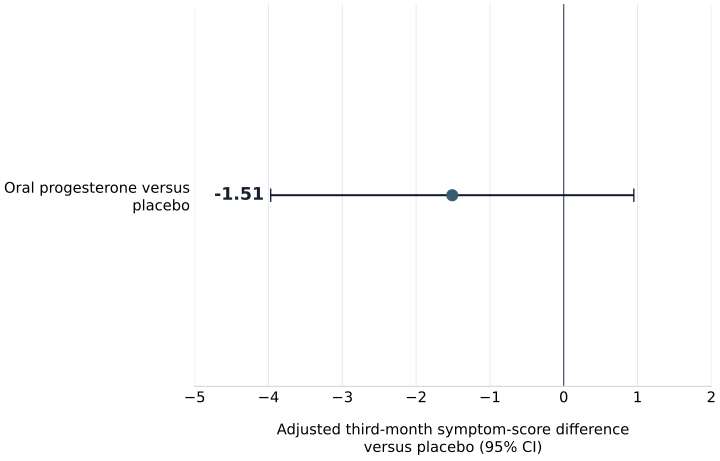
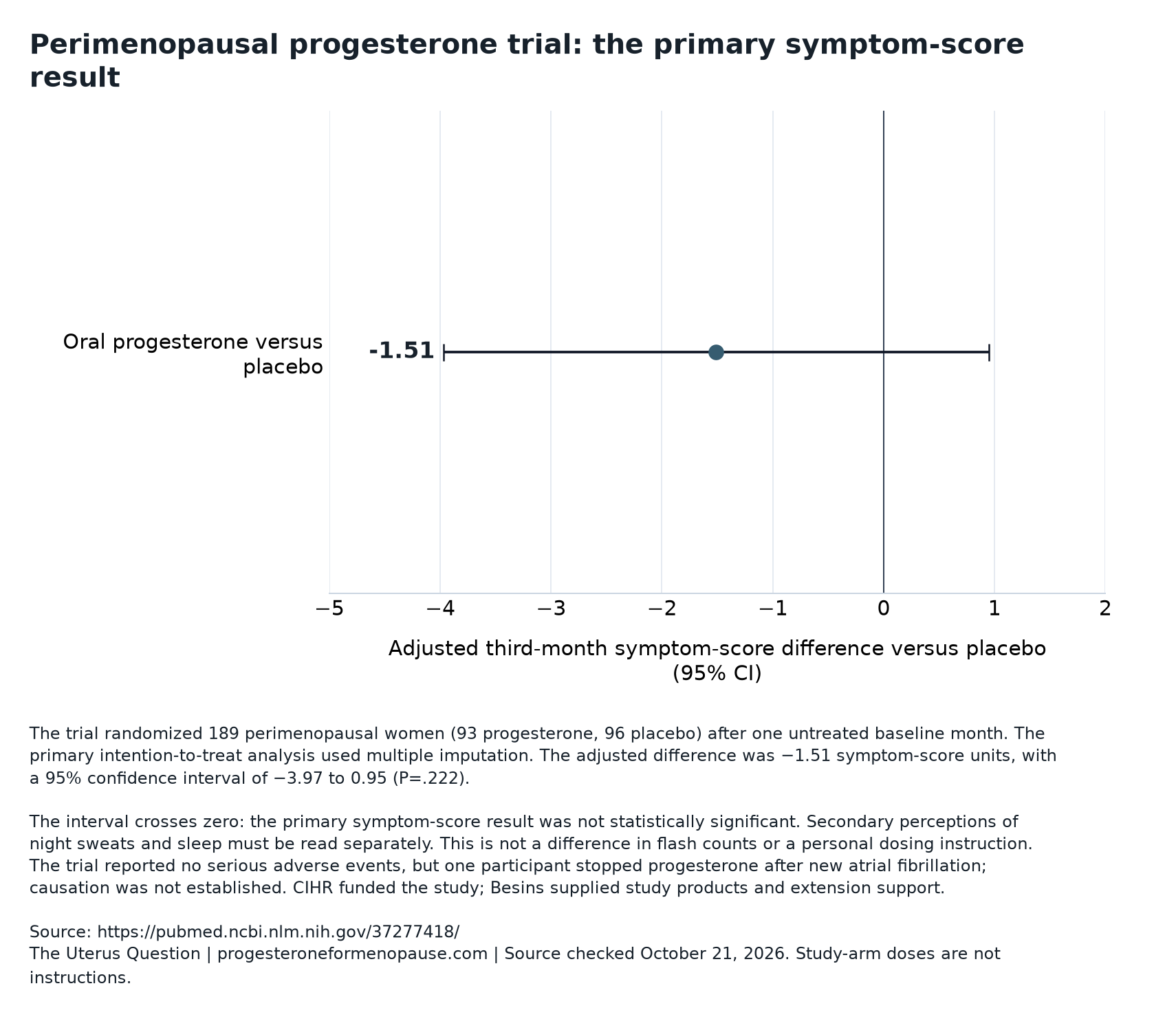
Primary finding: The adjusted third-month symptom-score difference was −1.51 points, with a 95% confidence interval of −3.97 to 0.95; P = .222. Source 1
Sleep findings: End-of-treatment perceived sleep quality favored progesterone, but calendar-recorded sleep problems did not differ between groups in month three. Source 1
Different treatment purpose: The US PROMETRIUM label includes endometrial hyperplasia prevention with conjugated estrogen tablets in postmenopausal women with a uterus, not progesterone-alone treatment of hot flashes or insomnia. Source 2
The trial asked about symptoms during the menopause transition
Vasomotor symptoms, abbreviated VMS, are hot flashes and night sweats. This study asked whether progesterone reduced their combined frequency and intensity in people still in the menopause transition. Eligibility required menstruation within the previous year and qualifying symptoms during screening and baseline recording. Nearly all randomized participants—186 of 189—reported awakening from night sweats at least twice weekly.
The baseline table classified 63 participants as being in early perimenopause and 126 in late perimenopause. Late-stage classification involved a cycle lasting at least 60 days or a skipped cycle. These are randomized-population counts; the smaller stage counts elsewhere in the report describe completers. Keeping those denominators separate prevents a misleading description of who entered the trial.
Participants were predominantly White, university educated, and employed, with an average body mass index of 26.7. Hysterectomy and removal of both ovaries were exclusions. Consequently, this trial cannot answer the distinct questions discussed in our guide to progesterone after hysterectomy. It also was not designed to establish treatment effects in people needing depression care.
Read the underlying chart data: download CSV or download the source-labeled chart.
Four study months meant three months taking treatment
The double-blind, randomized, placebo-controlled trial ran from 2012 to 2017. Researchers at the University of British Columbia managed it as a single-center study with Canada-wide recruitment; 93% participated remotely. National reach therefore did not make it a multicenter trial. Participants first recorded symptoms without experimental treatment for one month.
Eligible participants then received either oral micronized progesterone, 300 mg at bedtime, or identical placebo for three months. This identifies the experimental arms, not a recommended regimen. An independent statistician generated blocked randomization stratified by early or late perimenopause, and a pharmacist used a password-protected allocation website.
Most recent menopausal hormone therapy and combined hormonal contraceptive use was excluded. However, fewer than 10 participants were allowed to continue a stable progestin-releasing intrauterine device or low-dose transdermal progesterone. Calling every participant hormone-free would therefore overstate the design. Monthly contacts monitored well-being, adherence, and adverse events, while capsule counts and calendar records assessed medication use.
The primary score combined episode counts with intensity
Participants recorded the number and intensity of daytime hot flashes and nighttime sweats. Researchers calculated a daily score by multiplying daytime frequency by intensity, doing the same for nighttime symptoms, and adding the results. Monthly averages summarized these daily scores. The primary comparison was the third treatment month, adjusted for baseline symptoms and perimenopause stage.
A worked illustration helps explain the units: three daytime episodes rated intensity two plus one nighttime episode rated intensity three would produce nine score points. That is four episodes, not nine. A treatment difference of 1.51 score points therefore cannot be translated directly into 1.51 fewer hot flashes, a percentage of participants relieved, or a probability of better sleep.
At baseline, the overall average score was 12.2, with a standard deviation of 11.3—substantial variation around the average. Participants reported about 4.9 episodes per day. Because the score data were skewed and unusually dispersed, researchers used negative binomial regression rather than ordinary linear regression. Their reported ratio compares modeled mean scores; it is not a patient-level risk ratio for obtaining relief.
The primary result left both benefit and no benefit plausible
The adjusted third-month difference favored progesterone by 1.51 score points, but the confidence interval crossed zero and the result was not statistically significant. The interval extended from a 3.97-point advantage for progesterone to a 0.95-point disadvantage. The corresponding modeled score ratio was 0.79, with a 95% confidence interval of 0.54–1.15.
Researchers considered a three-point difference minimally clinically important. Their interval includes an advantage of that size, so the study did not rule out a meaningful benefit. But including a meaningful benefit within an interval is not evidence that the benefit occurred. The same interval also includes no difference. The most accurate conclusion is uncertainty, not a positive primary trial.
The third-month group averages were 5.5 with progesterone and 7.1 with placebo. Subtracting these gives a raw 1.6-point gap, which is close to—but not interchangeable with—the adjusted estimate. Frequency and intensity, examined separately, also failed to show statistically significant differences. Those results do not establish that one component improved while another diluted the combined score.
Third-month diary outcomes: adjusted progesterone-minus-placebo estimates
| Outcome | Adjusted difference (95% CI) | Interpretation |
|---|---|---|
| Combined VMS score | −1.51 points (−3.97 to 0.95) | Primary endpoint; uncertainty includes no difference and a potentially meaningful benefit |
| Episode frequency | −0.60 episodes per 24 hours (−1.50 to 0.29) | No statistically significant between-group difference |
| Episode intensity | −0.17 intensity units (−0.56 to 0.22) | No statistically significant between-group difference |
Recruitment and missing data explain part of the uncertainty
The original sample-size calculation called for 175 participants, assuming a standard deviation of 6.2 and allowing for discontinuation. A planned, blinded assessment during recruitment found greater residual variability: a standard deviation of 8.0. Researchers increased the target to 228 completing participants, but funding ended after 189 had been randomized and 176 completed.
Greater variability makes a treatment difference harder to distinguish from background fluctuation. Enrollment also demonstrated that fluctuation: 49 screened participants did not have enough symptoms during the baseline month to proceed. Both treatment groups’ scores subsequently declined. Improvement within the progesterone group alone therefore cannot isolate a drug effect; the placebo comparison is essential.
The primary intention-to-treat analysis retained the randomized groups and used 100 multiple imputations to estimate missing observations from available participant information. That approach does not make missing data disappear, but avoids simply discarding everyone with incomplete records. A sensitivity analysis in 176 participants with sufficient baseline and third-month calendar data gave a similar difference, −1.58 points, with a confidence interval of −4.00 to 0.84. It remained inconclusive.
Perceived sleep improvement was a separate, secondary signal
At the end of treatment, participants completed a questionnaire about perceived changes. Overall night sweats favored progesterone, with P = .023, and perceived sleep quality favored progesterone, with P = .005. These findings concern retrospective impressions across treatment, rather than the prespecified third-month combined diary score.
The distinction is particularly important for sleep. Calendar-recorded sleep problems and anxiety did not differ between groups in month three. A person’s overall judgment of sleep quality may capture something different from daily problem ratings, but the trial did not establish why the measures diverged. Better sleep could influence remembered nighttime symptoms; alternatively, less disruptive nighttime symptoms could improve perceived sleep. These data cannot determine the direction.
Perimenopause-related interference with daily activities also favored progesterone: the adjusted difference was −6.65 questionnaire units, with a 95% confidence interval of −12.11 to −1.18. Depression questionnaire scores did not differ. Taken together, these secondary findings justify more focused research, not a declaration that the primary trial succeeded or that progesterone treats insomnia, anxiety, or depression.
Safety reporting included a treatment stop for atrial fibrillation
The authors reported no serious adverse events during this short trial. They nevertheless described one physician-mandated discontinuation of progesterone after new-onset atrial fibrillation, an irregular heart rhythm. These statements should both be preserved: the report did not classify a serious adverse event, but it did document a clinically consequential cardiac event. It did not establish that progesterone caused it.
Mild-to-moderate side-effect reports were numerically more frequent with progesterone, 22 versus eight with placebo. Nausea or gastrointestinal problems were reported eight times versus once; dizziness occurred once in each group. The adverse-event table contains some inconsistent printed percentages, making the exact counts the clearer presentation. No statistically significant overall adverse-event difference does not establish equal safety.
The current US PROMETRIUM label warns about dizziness and drowsiness and lists peanut oil among its ingredients, with peanut allergy a contraindication. Other contraindications include unexplained genital bleeding, breast cancer history, thromboembolic disease history, and liver dysfunction. A historical statement about a Canadian study formulation should not override current US product ingredients. Sedation also is not, by itself, proof of restorative sleep.
A positive postmenopausal study does not resolve this result
A separate randomized trial studied healthy volunteers one to 10 years after their final menstrual period. It also tested oral micronized progesterone, 300 mg at bedtime, against placebo, with four baseline weeks and 12 treatment weeks. Unlike the perimenopausal study, its primary symptom-score result favored progesterone with a confidence interval that excluded zero.
The adjusted difference was −4.3 score points, with a 95% confidence interval of −6.6 to −1.9. Of 133 randomized participants, 114 had baseline and treatment symptom data for analysis. The indexed primary report abstract describes cardiovascular-risk screening and a selected healthy population. Funding is not identified in that abstract and should not be inferred from the later trial.
These studies differ in reproductive stage, symptom variability, participant selection, and analysis population. Comparing their estimates is informative but cannot prove that menopause stage changes the treatment effect; that would require a suitable direct analysis. Our postmenopausal progesterone trial analysis examines that evidence separately. For this comparison, the accessible evidence is the indexed primary report abstract, not a review of its full protocols or supplements.
Protecting the uterine lining is a different evidence question
Neither symptom trial tested whether progesterone adequately protected the endometrium—the uterine lining—during systemic estrogen use. That question has a different comparator, endpoint, and follow-up. The current PROMETRIUM label describes a separate randomized study of postmenopausal women with a uterus receiving conjugated estrogen tablets, cyclic progesterone plus those tablets, or placebo for up to 36 months.
Among participants with evaluable endometrial results, hyperplasia occurred in seven of 117 receiving the combination, compared with 74 of 115 receiving estrogen alone and three of 116 receiving placebo. Hyperplasia means abnormal thickening or growth of the lining; these are not cancer rates. The reported 6% versus 64% corresponds to a 58-percentage-point difference, not a 58% relative reduction.
The treatment arms and biopsy outcomes below show why a symptom response cannot substitute for protection evidence. Our guide to progesterone and systemic estrogen develops this distinction. Likewise, bleeding changes require their own assessment; the perimenopausal trial’s reports of stopped flow do not establish endometrial protection or explain unexpected bleeding on a hormone plan.
Three progesterone questions with different endpoints
| Evidence setting | Treatment comparison and follow-up | Main result or purpose |
|---|---|---|
| Perimenopausal symptom trial | Oral progesterone 300 mg nightly versus placebo; three treatment months | Primary VMS-score difference −1.51 points; 95% CI −3.97 to 0.95 |
| Postmenopausal symptom trial | Oral progesterone 300 mg nightly versus placebo; 12 treatment weeks | Adjusted VMS-score difference −4.3 points; 95% CI −6.6 to −1.9 |
| Label-described endometrial trial | Cyclic oral progesterone 200 mg with conjugated estrogens versus estrogens alone or placebo; up to 36 months | Hyperplasia: 7/117 combination, 74/115 estrogen alone, 3/116 placebo |
Funding, formulation, and follow-up shape the next questions
The perimenopausal trial received Canadian Institutes of Health Research funding. Besins Healthcare International supplied PROMETRIUM and identical placebo and made a university donation allowing another recruitment year. The authors declared no competing interests. These disclosures matter alongside the practical fact that recruitment still ended below the revised completion target.
A stronger next trial would need adequate enrollment for the observed variability and clearly prespecified sleep and nighttime-symptom outcomes. Longer follow-up would help characterize durability and uncommon harms. The present trial did not compare progesterone with estrogen-based therapy, establish hormone-level predictors of response, or test compounded creams, vaginal administration, or other formulations.
Editorial interpretation: when comparing care arrangements, the documented purpose of each medicine matters more than treating all progesterone claims as equivalent. Our care-comparison guide provides a framework; the Midi review and Evernow review can be used to check documentary terms, not infer trial-level outcomes. FDA labeling changes announced in 2026 do not turn these symptom findings into an approved indication or eliminate remaining product-specific warnings.
Questions about the evidence
Did progesterone work for perimenopausal hot flashes in this trial?
The trial did not demonstrate superiority over placebo on its primary combined hot-flash and night-sweat score. Its confidence interval still allowed a clinically meaningful benefit, so it also did not prove that progesterone has no effect. The appropriate conclusion is an inconclusive primary result with secondary signals warranting further study.
Why examine the sleep findings when the primary result was inconclusive?
Sleep quality is important and does not have to track a combined symptom score perfectly. However, perceived sleep improvement was a secondary, end-of-treatment judgment, while daily calendar sleep problems did not differ. The discrepancy is scientifically interesting but does not establish an insomnia treatment effect or explain the mechanism.
Does a 0.79 score ratio mean 21% more participants obtained relief?
No. That ratio compares modeled mean symptom scores between groups, not the proportion of participants obtaining relief. Its confidence interval, 0.54–1.15, includes equal mean scores. It cannot be converted into an individual probability of improvement or a number needed to treat from the reported information.
Does this study establish protection against uterine cancer?
No. It measured symptoms over three treatment months, not endometrial cancer prevention. The separate label-described study measured hyperplasia during conjugated estrogen treatment. Reducing hyperplasia is a different endpoint from demonstrating fewer cancers, and neither finding means every progesterone formulation or schedule provides equivalent protection.
Did the researchers review enough people to establish long-term safety?
No. A three-month treatment comparison involving 189 randomized participants cannot reliably characterize uncommon or long-latency harms. It did provide useful short-term observations, including more mild-to-moderate side-effect reports with progesterone and a treatment discontinuation after atrial fibrillation. Current product warnings remain relevant despite the absence of reported serious adverse events.
What this evidence supports
This trial adds useful evidence without settling progesterone’s role in perimenopausal symptom treatment. Its randomized design, daily recording, high retention, and sensitivity analysis strengthen the report. Greater-than-expected variability and incomplete recruitment limited precision. The primary outcome remained inconclusive; perceived sleep, nighttime symptoms, and daily-life interference showed secondary benefits. None of those symptom findings answers whether a particular regimen protects the uterine lining during systemic estrogen use. Those are separate clinical purposes supported by separate evidence.
Research access and limitations
This analysis uses the full perimenopausal research article and its displayed tables, the indexed primary abstract for the postmenopausal comparison, and official labeling and FDA material. Separate protocols and supplementary files were not independently examined. The perimenopausal article notes a 2024 correction to questionnaire values in Table 2. No participant-level reanalysis was performed.
Sources behind this article
Use the original documents to check their scope. A provider’s offer and a named medicine’s label establish different facts.
- Oral micronized progesterone for perimenopausal night sweats and hot flushes a Phase III Canada-wide randomized placebo-controlled 4 month trial.Indexed primary study abstract and full research article · Checked 2026-10-21
- DailyMed: current Acertis Prometrium progesterone capsule record, updated July 23, 2026Exact prescription product labeling · Checked 2026-10-21
- Oral micronized progesterone for vasomotor symptoms--a placebo-controlled randomized trial in healthy postmenopausal women.Indexed primary study abstract · Checked 2026-10-21
- FDA: first six menopausal hormone therapy label revisions, February 12, 2026Federal regulator announcement · Checked 2026-10-21